“Digital transformation” doesn’t quite capture it


In recent years “digital transformation” is central in executive priorities as businesses and organisations scramble to acquire the technologies and services that promise to make them “digital”. However the expression may be imprecise or erroneous at best and profoundly misleading at worst; the way executives and personnel understand it will shape the endeavours undertaken to address digitisation and ultimately greatly influence the outcome. The difference between success and failure sometimes has a lot to do with the choice of words.
“To misname things is to add to the unhappiness of the world” — Albert Camus
Not the right word
Considering the changes in consumer behaviour, business practices, politics and nearly every other facet of modern life, the expression “digital transformation” appears to be failing to capture the nature of the phenomenon and seems misleading for many management teams. The word transformation:
- implies that some pre-existing form ceases to exist so that a new form may emerge, which is in itself a problem at least when it comes to bringing the topic on the agenda with existing organisations because no organisation wants to cease to exist and no individual within such an organisation is very keen on being made redundant. Of course any form of change is always source of stress and therefore faces resistance, but its is of critical importance to carefully manage this tension if digitisation is to succeed;
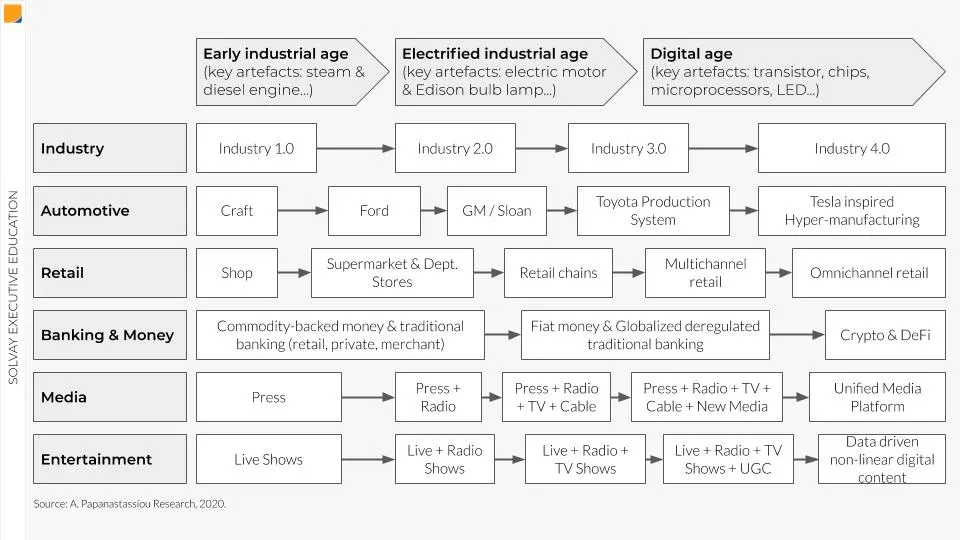
- speaks of a path from the former to the latter form and also means that the end point is a stable form that is to remain for some time. As a result there is a lot of focus placed on defining a theoretical end point for the organisational form that is supposed to be able to address digitisation or for the tools and solutions that are supposed to enable it, and maybe not enough attention paid to the process of transition from an initial situation considered unfit for a digital economy to a better situation. The process is where the value lies especially in a rapidly changing economy where disruption can come at any time. In such situations it is far more valuable to develop the skills and methods required for the organisation to adapt fast and in an appropriate way than to try to figure out what the optimal form should be for the understanding we have of changing conditions at a given point in time. There is more value in being inspired by complex adaptive systems like ecosystems than by rigidly defined structures.
Therefore “digital transformation” may have become the standard way of talking about digitisation but it remains a poor choice of words because words shape the way we think about and act on something. In speaking about “digital transformation” we misname an important phenomenon. That has several consequences in the way in which management teams address digitisation as the economy starts relying more on digital technologies and the interconnectedness they make possible.
Errare humanum est, sed…
Some of the major misconceptions and erroneous ways to address digitisation include:
- seeing the effort to adapt as a program of limited duration that is supposed to give birth to a new form of their business that can be branded “digital” and therefore be off the digital hook, so to speak;
- examining practices and tooling used by digital native companies and trying mimic them by forcing the adoption of organisational forms and practices by the company to be transformed, often failing to understand the many pre-requisites and complex interactions that lead to the emergence of specific organisational forms and ways of working;
- researching about software tools and technologies that their makers market as enablers of “digital transformation” and launching some major technology roll-out program that’s supposed to make the organisation “digital”, whatever that means;
- hiring expensive consultants without knowledge of the company if not without specific industry expertise to drive a transformation effort (often conceived, structured and executed as per item #1 of this list);
- focusing on the customer touchpoints in an attempt to engineer a “seamless” “user experience”, sometimes with digital agencies and in other cases with the digital arms of BigX consulting firms or of incumbents in the advertising & communication business, without any sort of consideration for internal processes and operational teams that are supposed to deliver on the promise and expectations created in contacts with customers.
Get Alexandre Papanastassiou’s stories in your inbox
Join Medium for free to get updates from this writer.
In this context and , “digital transformation” is exploited by all sorts of companies to push more of their wares with a promise to give their anxious and lost executives access to digital nirvana. Software houses sell “experience suites” and “digital platforms”. Consultants sell “transformation methodologies” and “digital experts”. Agencies sell “consumer experience” and “consumer journey designs”. All of them are making a business of the lack of clarity in the minds of executives, who live under the constant assault of all sorts of communications, offers and claims designed to capture their attention and to convince them to embark on “digital transformation journeys”.
More like evolution
This is a world of confusion that badly needs a return to the fundamentals of what is what and some sound thinking about what we know for sure about digitisation. Therefore let us try to outline some of the important aspects of the phenomenon and then see what the implications are:
- digitisation reduces the cost of innovation, e.g. by way of rapid prototyping, use of open source code, through software simulations designed for materials engineering, use of open data or indeed by having easy connections to hugely concentrated clusters like Shanghai’s activity in robotics that makes it a global hub able to produce robot prototypes in a few days where other places around the globe need weeks or months. For companies this means both that (i) it opens new paths of evolution (therefore it is necessary to foster a culture that embraces opportunity and seeks the new) and (ii) it intensifies competition by new entrants;
- digitisation enables rapid and frequent change, as many functions adopt the “fly by wire” pattern it becomes easier to reconfigure devices to have different capabilities, e.g. the pace at which new features are being rolled out in Microsoft’s Teams tool generates great turbulence for Slack; continuous delivery and testing of features as performed by Spotify is another example;
- digitisation changes the balance of power between parties to economic transactions, e.g. between buyers and sellers where online communities organise group buying, between brands and distribution when Amazon is operating a marketplace or between employers and employees when expertise can be sourced globally;
- digitisation forces companies to rewire their processes and automate where they can, e.g. through the emergence of platforms like Zapier, Integromat, Automate or Microsoft’s Flow (now Power Automate), or even low code solutions like Airtable that make it possible to streamline the operations of a company and to adapt them continually to whatever the customer facing services dictate. That is valid up to a certain level of depth in the processes of a business, where there will necessarily be a lesser degree of flexibility for rapid and frequent change;
- digitisation increases the need for doers and changes the role of management because it shapes a world in which many things can evolve through trial and error and where the number of iterations defines the degree of learning of a business system, which means that command and control style management will be less powerful than distributed organisations that give a lot of autonomy to their edges, to the people who operate closest to the market.
What counts is not that much whether an organisation is “digitally” the strongest or most competitive, but rather how capable and how fast an organisation is to understand its changing economic context and adapt
All these facets of the digital phenomenon paint a picture of constant change, continuous interactions, loose coupling between organisations, influence from small factors somewhere in the economic network causing large consequences somewhere else, permanent interdependence, significant changes in ways of working and behaviours and more fluid consumer decision journeys. In such a context no one can hope to run a program of digital transformation once and to be off the hook. In such a context, what counts is not that much whether an organisation is “digitally” the strongest or most competitive, but rather how capable and how fast an organisation is to understand its changing economic context and adapt its ways of dealing with it to achieve the best possible performance.
Digital requires a Darwininan approach of continuous business evolution
Therefore we should not really be talking about digital transformation, but rather about how to build into the culture, know-how, way of working, management methods and tooling the required ability to evolve so as to be fittest to succeed in a connected and changing economy. Digital requires a Darwininan approach of continuous business evolution. That’s as remote from digital “transformation” as gardening is remote from civil engineering, in the sense that it’s more about triggering a continuous process and a new way of being than about achieving one set of more or less linear transitions from given forms to new forms.